


5 THESES ON THE SMILEY REVOLUTION
1. ARE YOU A LANGUAGE PURIST? THEN YOU MUST SUFFER!
Do you still receive short messages without emojis? Probably rarely. Unless your circle of friends consists exclusively of German scholars who either consider themselves responsible for Germany’s linguistic cultural heritage or possess a nostalgia gene that compels them to praise pre-digital times.
But this small group is the exception, because we are all under the emoji blanket and in the midst of a change in communication culture. Personal conversations and even phone calls are out. Instead, we type or send voice messages until we crash into a lamppost. The new writing style that characterizes our short messages has the nature of a personal dialogue and shines through its utmost informality. Especially the younger generation deliberately violates language rules and is by no means (only) stupid in doing so, but possibly highly creative. Because “Gehma 🍺” is absolutely understandable!
Opposite this stands the norm. High German, the unshakeable rock of linguistic culture. If this rock moves significantly, as it is currently, the demise of culture is prophesied. But change is unstoppable, and we can only welcome creative expansions – and uphold the flag against actual linguistic neglect!
2. OUR DIGITAL NATIVES ARE (PROBABLY!) NOT GETTING DUMBER AFTER ALL.
A study compared German essays by fifth graders with their online statements – the result: Students usually know exactly in which texts formality is required and when they can break rules. However, a completely different discussion arises from the increasingly widespread pedagogical approach that spelling is less important than the content of our prodigies. Unfortunately, this leaves behind people with neglected orthography who will simply struggle later in life. But back to digital writing: different language styles are used intuitively depending on the medium, and spelling mistakes remain just as silly here:
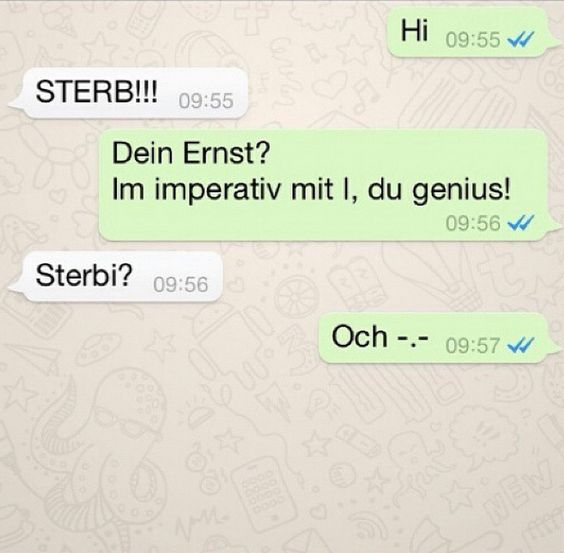
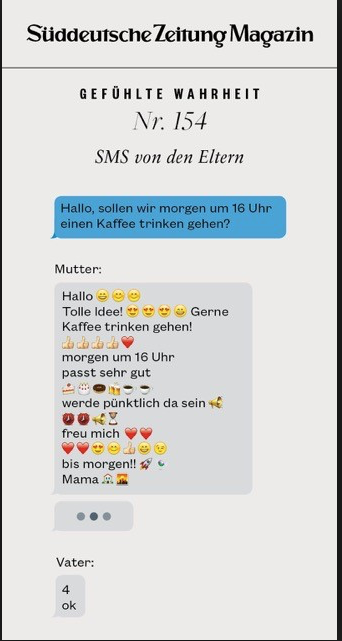
In the digital realm, communication is highly colloquial, in a condensed telegram style, sometimes deliberately in Kiezdeutsch (e.g., “Treffen wir uns Bahnhof?” – “Shall we meet train station?”) – and spiced with emojis, with the frequency of use differing by gender (Source: Süddeutsche Zeitung):
3. THOSE WHO DON’T USE EMOJIS ARE CONSIDERED TOUGH.
Have you ever consistently tried to compose short messages without emojis? From personal experience: It’s becoming increasingly difficult not to cause irritation. If you punctuate your message with normal punctuation, it appears formal, and it’s hard to establish the desired closeness with the recipient. It seems we only trust the correct interpretation of our own message if it’s garnished with images. Facial expressions, gestures, and tone of voice, which convey the meaning of a statement in personal conversation, are replaced by emojis in digital writing. Emojis usually reinforce the statement, e.g., when I add a crying face to an “really sad.” Or they indicate: “Hello! My statement is meant ironically!” Or they are simply used for fun, because then everything is so colorful here.
4. CAUTION IN PROFESSIONAL LIFE – UNLESS YOU ADHERE TO THE PRINCIPLE: BE SMART, PLAY DUMB.
When emails with emojis arrive in professional life, they are perceived as inappropriate – almost as much as email signatures set in Comic Sans. One gets the feeling that the sender cannot be taken entirely seriously. The Israeli Ben-Gurion University confirms this in a study with the charming name “The Dark Side of a Smiley. Effects of Smiling Emoticons on Virtual First Impressions”: Smileys signal incompetence! And people who received emails with emojis write back with fewer facts. Why would they, if they consider the other person a dummy?
5. EMOJIS IN MARKETING ARE FOR EXPERTS
In the social media communication of consumer brands with young target groups, one can see how established the new language form already is. Written text is supplemented and emotionally decorated. (Source: Instagram: dm_deutschland).

A study even proves that Instagram posts with emojis get 17% more interactions. But: The older the target group gets, the more the value decreases. This is not necessarily surprising (see 1.!)
Three things must be kept in mind in advertising communication:
• Firstly, emojis can be misunderstood,
• secondly, emojis are currently only popular with a specific target group, and
• thirdly, an overzealous use is annoying.
It’s like everywhere in communication: The address must be authentic for the target group, otherwise the smiley will backfire.
In addition, when we move outside the common social media networks: Emojis are protected, and each provider has its own emoji set. If you want to use them for commercial purposes, you have to acquire licenses – or design your own.
And where is all this leading? Nobody knows. At the moment, emojis are an additional component of our linguistic toolkit, but whether they will survive in the long term, nobody knows. Perhaps they will soon be as antiquated as their predecessors, the emoticons ;-). But they will probably not disappear, but undergo technical development.
(On a personal note: The author has stubbornly resisted the use of emojis in private life so far, but she is slowly being softened up… 😄)